
BEGINNER GUIDE · 6 MIN READ
Why counted cross-stitch helps beginners stick with it
Counted cross-stitch is a grid hobby: you follow a chart, count fabric holes, and fill each square with a full X. Many stitchers come for calm, hands-busy focus and handmade gifts — not because it “fixes” stress overnight, but because a finishable chart helps beginners stick with it. Stitchplot’s browser CT mode turns a photo into a counted chart with DMC colours (up to 10), fabric 11–36ct, free SVG, and PDF via credits — no subscription. This page covers everyday benefits, a starter checklist, and what to expect from a photo chart — not medical advice or a Studio tour.
What counted cross-stitch actually is
Counted cross-stitch starts with blank fabric (usually Aida or evenweave) and a chart. You count the holes, match each square to a symbol, and stitch one full cross per square. That differs from stamped designs, where the motif is already marked on the cloth.
Every stitch sits on a grid, so progress is countable. Fabric count (stitches per inch) sets how large that grid finishes — use Cross-stitch fabric count and finished size for the maths.
Weighing it up against canvas work? See cross-stitch vs needlepoint.
Calm focus, one stitch at a time
The rhythm is simple: find the next symbol, count, stitch the X, move on. Many stitchers describe that loop as a screen break — hands busy, attention on the next stitch rather than a scrolling feed.
Needlecraft research — including a large survey of knitters and a recent review of sewing, embroidery, and related crafts — has linked regular stitching with calm focus, a sense of progress, and social connection for many people. Counted cross-stitch shares that rhythmic, hands-busy pattern, but it is a hobby support, not a substitute for professional care.
That calm is easier to keep when the first project is small enough to finish.
Visible progress, gifts, and finishing small projects
Unlike much screen work, cross-stitch leaves colour on fabric. You can hold the hoop and see how far you have come, and you pick up chart-reading, counting, and colour changes along the way.
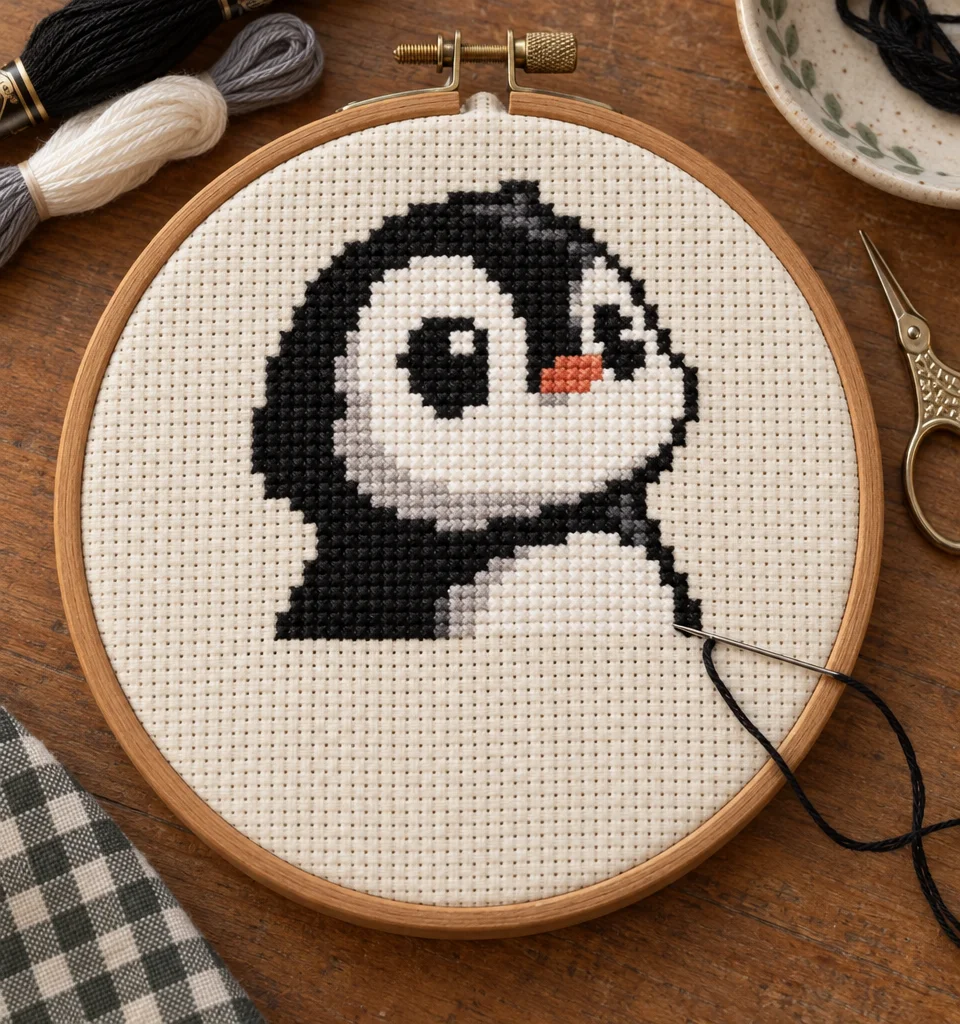
A finished hoop — a keepsake, a gift, a simple motif — carries an “I made this” feeling that brings people back. Keep the first piece modest so it actually leaves the hoop.
A practical starter checklist
Use this as a guide for a first project you can finish, not a promise of hours-to-finish.
| FIRST PROJECT CHOICE | AIM FOR | WHY |
|---|---|---|
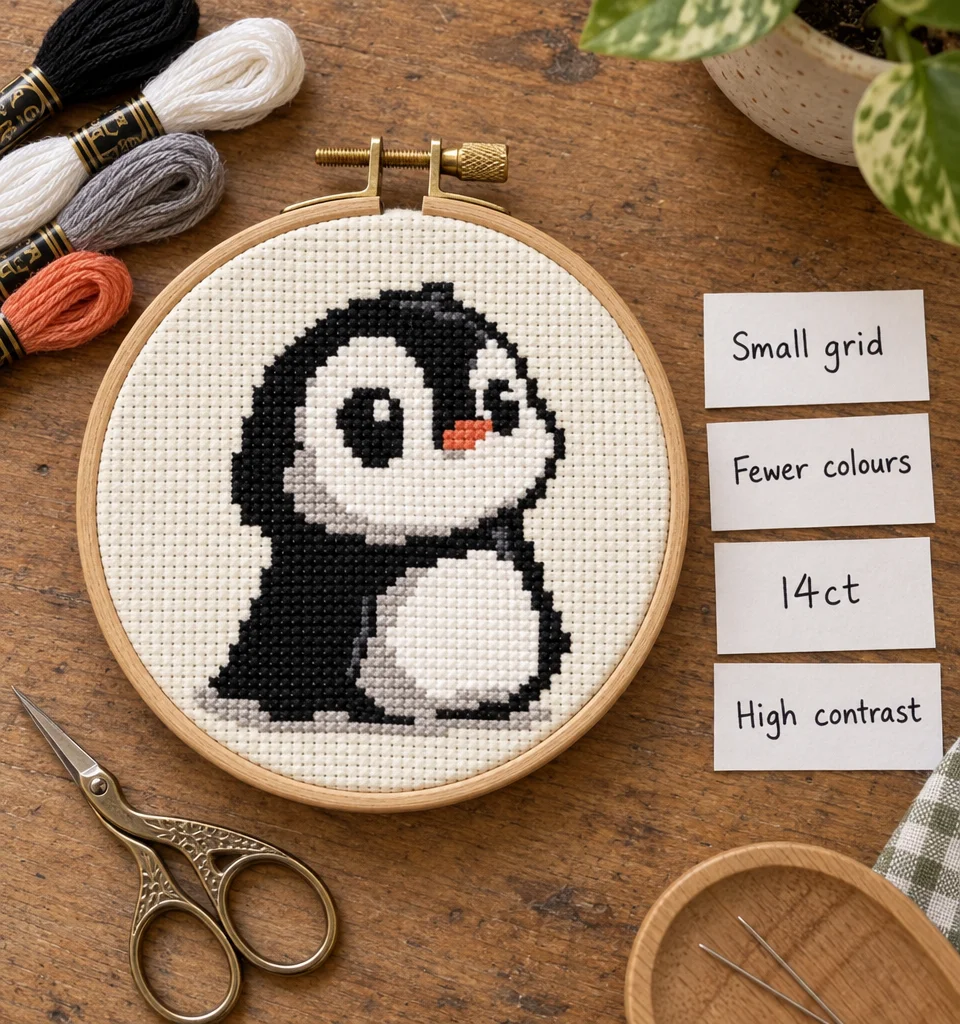
| Small stitch grid | Under ~80×80 stitches | Faster visible finish; fewer places to lose count; beginner-friendly first hoop |
| Colour count | 3–8 colours (max 10 in Stitchplot) | Fewer thread changes, clearer chart symbols |
| Fabric | 14ct Aida; see fabric-count guide for finished size | Holes large enough to see and count easily |
| Image type | High contrast, clear subject | Cleaner CT conversion; less muddy symbol soup |
A modest grid (under about 80×80) stays in small-hoop territory — on 14ct, 80 stitches span roughly 5.7 in each way. Aim for 3–8 colours so symbols stay readable; Stitchplot’s CT mode caps at 10 DMC-matched colours. 14ct Aida suits beginners because its holes are easy to see and count, and the finished piece is still a manageable size. For centimetres and inches at other counts, open Cross-stitch fabric count and finished size. High-contrast photos with a clear subject convert more cleanly than busy, low-contrast images.
Why counted charts help beginners stick with it
Counted charts help because the next stitch is usually obvious: a symbol, a legend, and a known fabric count. You are not inventing placement stitch by stitch.
Sticking with it often comes down to a short loop. Smaller first grids and fewer colours mean an earlier finish, and an early finish makes the next piece easier to start. Charts made from photos work the same way: start small rather than stretching a huge first chart.
Turning a photo into your first counted chart
When you want a chart from your own photo or artwork, Stitchplot’s browser Studio CT mode is the path: choose fabric 11–36ct, match up to 10 DMC colours, edit symbols, then export free SVG or unlock a print-ready PDF with credits — no subscription. For a tour of the controls, read Meet Stitchplot Studio. For the step-by-step path, see How it works. For what the unlock file contains, see What’s in a Stitchplot print-ready PDF.
What to expect from a first photo chart:
- High-contrast photos with a clear subject chart cleaner in CT conversion.
- Stitchplot matches up to 10 DMC colours — fewer colours on a first chart usually means clearer symbols and fewer thread changes.
- Start small on the stitch grid (see the checklist above) so a first finish is realistic.
- 14ct Aida is a comfortable first fabric because the holes are easy to count; use Cross-stitch fabric count and finished size for finished-size maths.
- Editing still matters after conversion — clean up muddy areas and check symbols before you stitch.
- Not every photo converts perfectly — busy, low-contrast, or tiny-detail images need more editing or a simpler subject.
FAQ
Quick answers
Is cross-stitch good for beginners?
Yes, when the first chart is finishable: a modest stitch grid, a short colour list, and fabric you can count comfortably (many start on 14ct Aida). Counted charts give a clear next stitch.
Is cross-stitch relaxing or mindful?
Many stitchers find the count-and-stitch rhythm calming and a good break from screens. It is a hobby, not a clinical treatment.
What’s the difference between counted and stamped?
Counted work uses blank fabric plus a chart — you count holes to place each stitch. Stamped designs already show the motif on the cloth.
Can cross-stitch help with stress or anxiety?
Some people find the rhythm calming as a hobby support. It is not medical advice, not a diagnosis, and not a substitute for professional care.
How do I get a chart from my own photo or artwork?
Upload in Studio CT mode, choose fabric and colour count, then edit. High-contrast, clear subjects convert more cleanly; busy photos need more editing or a simpler crop.
How big will my chart be on 14ct or 18ct?
Finished size is stitch width ÷ fabric count (same for height). For worked tables, use Cross-stitch fabric count and finished size.
Do I need a subscription for Stitchplot?
No. Creating, editing, and SVG export are free; print-ready PDF uses account credits. There is no subscription.
Open Studio with a small first chart
Pick a high-contrast subject, keep the stitch grid modest, and aim for a short colour list — then Open Studio and try a small first CT chart. Also useful: How it works, Meet Stitchplot Studio, Cross-stitch fabric count and finished size, and What’s in a Stitchplot print-ready PDF.